


A patient walks into the pharmacy wanting to start the pill. She has monthly migraines, a blood pressure of 148/92, and a BMI of 33 — a combination that raises a number of safety concerns for certain methods. This scenario applies the 2024 US Medical Eligibility Criteria step by step to determine what a pharmacist can safely prescribe, why some methods are off the table, and when a progestin-only pill can be the right answer for a patient.
The scenario:
A 24 year-old patient comes into the pharmacy and is interested in initiating pharmacist-prescribed birth control. She has been sexually active with one male partner for the last 8 months and currently relies on external (male) condoms. She expresses interest in a pill because she wants something discreet and reversible but is open to pharmacist recommendations.
She reports irregular cycles over the past year, with periods ranging from 26–38 days. Her last menstrual period (LMP) was 11 days ago. She denies recent unprotected intercourse since her LMP.
Medical History
- Migraines without aura (diagnosed 3 years ago) — occur ~1x/month, managed with sumatriptan
- Mild intermittent asthma — uses albuterol inhaler PRN
- BMI: 33 kg/m² (weight: 210 lbs, height: 5’7”)
- Blood Pressure: 148/92 mmHg (measured today in the pharmacy)
- No history of VTE, stroke, or cardiovascular disease
Medications
- Sumatriptan 50 mg PO PRN migraines
- Albuterol inhaler 90 mcg PRN wheezing
- Vitamin D 1,000 IU daily
- Occasional ibuprofen 600 mg for cramps
Insurance:
Birth control coverage, prefers affordable options
For the purposes of contraception initiation, what information about the patient is relevant to the visit today?
Key factors to assess related to the safety profile of contraceptive methods include:
- Migraines without aura
- Elevated BMI/weight
- Blood Pressure: 148/92 mmHg
- Patient preferences
Migraines and hormonal birth control
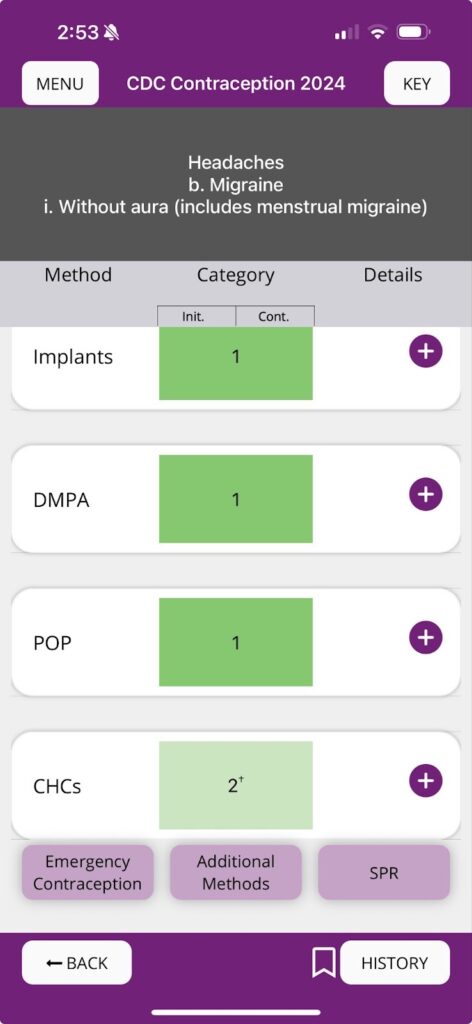
It is important to confirm the absence of aura with her migraine headaches. Ask the patient if she has symptoms that occur before or during a migraine headache — these are often visual disturbances such as flashing lights, lines, shapes, or vision loss. Auras may also present as tingling in the face or limbs or ringing in the ears. For migraine without aura, combined hormonal contraception (CHC) is US Medical Eligibility Criteria (USMEC) Category 2 (advantages generally outweigh theoretical or proven risks). All other methods are considered USMEC Category 1 (no restrictions). Patients should report any new headaches or changes in their headaches.
Obesity and hormonal birth control

There are no contraindications (USMEC Category 4) or increased risks (US MEC category 3) for estrogen-containing methods for individuals with elevated BMI. These are listed in the USMEC under “Obesity.” Measuring weight and calculating BMI at baseline may be helpful for discussing concerns about any changes in weight and whether those changes might be related to use of the contraceptive method.
The CHC transdermal patches are contraindicated in BMI ≥30 kg/m2 due to reduced efficacy.
High blood pressure and hormonal birth control
The patient has an elevated blood pressure reading. In this case, CHCs are USMEC Category 3 due to the estrogen component.

If your state allows pharmacist prescribing of self-administered contraceptive forms (pill, patch, and ring), what would you recommend for the patient at this time?
According to the 2024 US Medical Eligibility Criteria, of the available options the patient could be offered the progestin only pill (POP) as it is USMEC Category 1 (no restrictions). There are three POPs available – drospirenone, norethindrone, or norgestrel. Norgestrel is available nationally as an over-the-counter (OTC). One of these oral contraceptives may be the best option considering the patient’s interest in a pill.
If the patient were interested in other methods, they could consider continuing the use of external (male) condoms or be referred to a provider that can administer DMPA or place alternate options for contraception such as the hormonal implant or an IUD depending on the patient’s desired method. The patient should be monitored for increases in weight, especially with DMPA use.
What if she had migraines with aura?
Migraines with aura increase the risk of stroke; estrogen-containing birth control adds to this risk and is a USMEC Category 4 in patients suffering from migraines with aura. POPs or DMPA would still be the best option available from a pharmacy setting.
What if her blood pressure reading was normal?
In this scenario, the patient could consider initiating the CHC vaginal ring, CHC oral tablets or a POP. The CHC transdermal patch would still be contraindicated due to her elevated BMI.
Key Points
- Elevated blood pressure is a USMEC Category 3 condition for CHCs (pill, patch, and ring).
- Many safe contraceptive options exist for patients with contraindications to estrogen containing contraceptive methods.
- Pharmacists can play a pivotal role in supporting reproductive autonomy and well-being among patients with medical conditions.