


A patient transfers into your practice with an ASCUS cytology, a reflex positive HPV, and no follow-up three months later. This scenario walks through applying the ASCCP Risk-Based Management Guidelines. It also covers why the guidelines are built around CIN3 risk rather than cancer risk, and the counseling points that help patients understand an abnormal result.
The scenario:
A 29 year-old patient (they/them) is transferring care into your practice. They show you that their medical record from a previous provider, pulled up on their phone, includes an ASCUS cytology with reflex positive Human Papillomavirus (HPV) three months ago without follow-up. They pull up other records on their cell phone of a prior normal cytology test at age 26. “What do I do now? I’m worried that I have cancer.”
What clinical tool can you use to determine the most appropriate follow-up steps for the patient’s abnormal pap results?
You can look at the ASCCP Risk Based Management Consensus Guidelines with your client to identify the next step based on their level or risk. You can do this in the article itself, but it’s slightly easier to use the online web or mobile apps (instructions are here).
For this clinical scenario, you enter the latest HPV and cytology results followed by previous results:
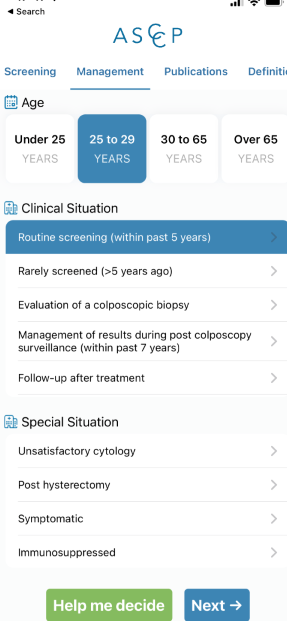
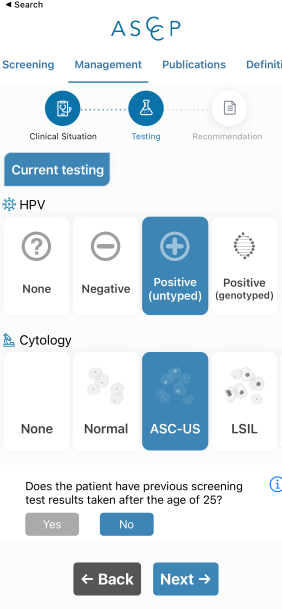
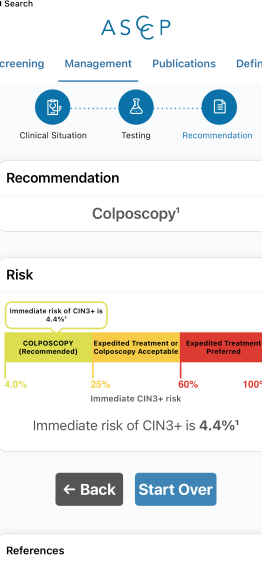
ASCCP Management Guidelines App, version 1.6. Screenshots used with permission of ASCCP.
The app then provides a recommendation based on the immediate risk for Cervical Intraepithelial Neoplasia grade 3 (CIN3), as well as references. The 2019 ASCCP Risk Based Management Consensus Guidelines also provide guidance about management of biopsies and additional follow-up after colposcopy.
Colposcopy is recommended for any person with CIN3 of over 4%.
For this scenario, the risk of CIN3 or higher today is 4.4%. As such, the next step should be counseling and a colposcopy.
Why is the recommendation based on CIN3 risk, not cervical cancer risk?
The 2019 ASCCP Risk Based Management Consensus Guidelines recommend follow-up testing and treatment when the immediate risk of at least CIN3 or higher, a.k.a., high-risk dysplasia, is greater than 4%. CIN3+ was chosen as an endpoint instead of cancer because cervical cancer is not common in the US and progression from CIN3+ to cancer can be stopped with treatment. The risk level is based on cervical screening results over time and age, not just the last test results. Any person with a clinical situation having an immediate risk of CIN3 of over 4% receives the recommendation for colposcopy.
What are key counseling points to share?
When counseling patients about abnormal cytology or HPV results, here are a few things to keep in mind:
- HPV is the most common infection passed through sex. In fact, HPV is so common that almost everyone will get HPV at some point in their lives.
- Having HPV or abnormal cytology doesn’t mean that you will automatically get cancer, but it does mean that you will need additional testing and closer follow up.
- Some types of HPV are more likely to cause cancer in the cervix because of how they grow and change the cells. But the good news is that they grow very slowly, so the changes often happen over years.
- The best way to prevent HPV infection is to get an HPV vaccine. Since HPV is passed by skin-to-skin contact, using condoms or internal condoms when having sex can decrease (but not eliminate) the risk of HPV infections.
There are good online tools for explaining this to patients, such as this Bedsider article, this online presentation designed to help avoid overtreatment for abnormal cervical screening, and this website by ASCO which discusses prevention of cervical cancer with an emphasis on HPV vaccination and screening. There are also free handouts here and here from the Journal of Midwifery and Women’s Health and here from the American Cancer Society.
How have cervical cancer guidelines changed over time?
Before 2012, cervical cancer screening and treatment guidelines focused on what to do next solely based on test results. Since then, large studies of longitudinal datasets of cervical screening tests and results have resulted in more precise estimation of risks based on age, current test results, and previous documented results. The 2019 ASCCP Risk Based Management Consensus Guidelines for management of abnormal cervical cancer screening focus on improving cervical cancer screening by identifying who is most at risk for high-grade dysplasia and avoiding overtreating people who are at lower risk.
What about patients who do primary HPV testing for cervical cancer screening?
The 2019 guidelines accommodate the three currently available cervical screening strategies: primary human papillomavirus (HPV) screening, co-testing with HPV testing and cervical cytology, and cervical cytology alone. HPV testing is the cornerstone of this approach, but it is evolving to include other tests like HPV genotyping (testing for the highest-risk HPV types, 16 and 18, which are most likely to lead to cervical cancer). Eventually other tests may be included to help identify people at highest risk and avoid sending people at lower risk for follow-up colposcopy and biopsy tests. Especially in young people, low-grade cervical abnormalities often resolve on their own without additional tests or treatment. And in some but not all studies, treatment has been associated with complications such as preterm delivery.
Key Points
- The 2019 ASCCP Risk-Based Management Consensus Guidelines are an important tool for improving cervical cancer screening and follow-up by identifying who is most at risk for high-grade dysplasia and avoiding overtreating people at lower risk.
- The 2019 ASCCP Risk-Based Management Consensus Guidelines are available for free online and through an app for a fee.
- The guidelines are updated based on the latest in new technology by a multidisciplinary group including client and professional groups, such as Team Maureen, Cervivor, American College of Nurse-Midwives, American College of Obstetricians and Gynecologists, American Academy of Family Physicians, American Cancer Society, and the National Cancer Institute.