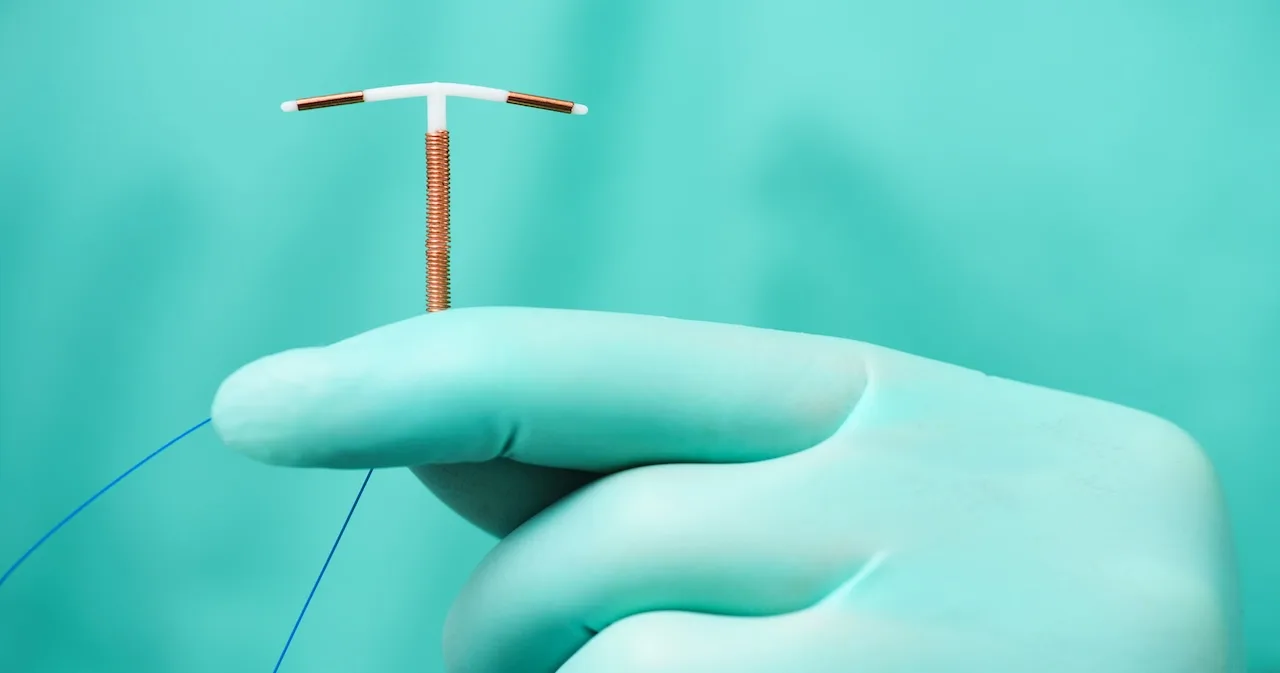


Counseling on postpartum IUD placements can be a clinically nuanced conversation between providers and patients. Timing, eligibility, and patient counseling all matter. This scenario walks through a 4-week postpartum visit to illustrate how to apply US MEC and US SPR criteria, assess perforation and expulsion risk, counsel patients in plain language, and fit same-day IUD placement into a busy schedule.
The scenario
A 23-year-old G1P1 (she/her) is coming in for her first postpartum visit after a normal spontaneous vaginal delivery. She was supposed to come for a 2-week check-in, but missed the appointment. She is now 4 weeks postpartum. She reports the baby is doing well. She is feeling fine, currently breastfeeding and tells you she stopped spotting “a while ago.” She had vaginal sex with her partner 2 days ago for the first time since delivery and they used a condom. Toward the end of her pregnancy, she indicated she wanted to get a copper IUD and now asks you if you can place it today. Her partner went back to work and childcare for an extra visit is difficult.
Can you safely place an IUD at 4 weeks postpartum?
Yes. There’s nothing in her history that means she couldn’t get an IUD today.
Two things to confirm:
- Medical eligibility: At ≥4 weeks postpartum, both copper and LNG-IUDs are US MEC Category 1, breastfeeding or not. Many providers still default to 6 weeks as the standard postpartum IUD placement time, but that’s often based on when patients come in, not evidence-based guidelines.
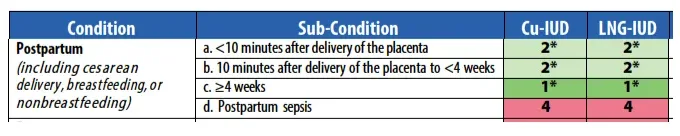
(Nguyen, 2024)
- Reasonable certainty she’s not pregnant. She’s breastfeeding, has had no return of menses (postpartum spotting is lochia, not a period), and is <6 months postpartum. If she’s fully or nearly fully breastfeeding, she meets the US SPR criterion outright. She’s also had one act of intercourse since delivery and she used a condom. If you’re unsure how exclusive breastfeeding is, you can run a pregnancy test (UPT).
Two additional considerations:
- Most patients don’t need STI screening before IUD placement. If she has risk factors and hasn’t been screened, you can collect samples at the time of IUD placement.
- If she had reported unprotected sex in the last 5 days, the copper IUD would work as EC in addition to ongoing contraception. Not the case here, but important to remember for other situations.
What is the risk for perforation in a postpartum patient?
Perforation risk is low overall, but the risk is higher in the first six weeks after delivery.
A 2023 study looked at more than 326,000 insertions in U.S. practice and found a cumulative incidence of perforation of 0.21% at 1 year of use. Risk was higher in the first year postpartum and highest for placements between 4 days and 6 weeks postpartum (aHR 6.71, 95% CI 4.80-9.38) compared with nonpostpartum placements. Breastfeeding was also independently associated with a slightly higher risk.
She has both factors, but the absolute risk remains low. In practice:
- Do a careful bimanual before you start. Uterine position and flexion help guide your placement approach.
- Avoid forceful sounding. If needed, an os finder or endometrial biopsy pipelle can confirm the path with less force.
- If the device doesn’t pass easily, stop and reassess.
What is the risk for expulsion in an IUD placed 4 weeks postpartum?
The missed 2-week visit worked in her favor here, since the risk for expulsion drops the further out someone is from delivery.
Expulsion risk by IUD placement timing postpartum
| Placement timing | Complete expulsion prevalence | Adjusted RR |
| Immediate post-placental (≤10 min after placenta) | 10.0-10.2% | 7.63-8.33 |
| Early postpartum (>10 min to <4 weeks) | 8.8-29.7% | 5.27-6.17 |
| Interval (≥4 weeks) | 1.8-1.9% | 1.00 (ref) |
At 4 weeks she falls into interval placement, the lowest-risk window, at around 2%. She’s parous, has no history of heavy menstrual bleeding, and no prior expulsion.
How can I counsel patients on postpartum IUD placement risks?
Perforation:
- Explain what it is.
- Share that it’s uncommon, but somewhat more likely at 4 weeks postpartum and while breastfeeding.
- Pair this information with what you do to lower the risk during placement.
Expulsion:
- Review potential symptoms including:
- strings that feel longer or shorter,
- firm plastic at the cervix,
- a change in cramping or bleeding
- a partner feeling the device.
- If they notice any of these, use a backup method during sex and schedule an appointment to see a provider.
Some sample language for how to succinctly discuss these risks:
We can place the IUD today. Two things I want you to know about. The first is perforation, where the IUD goes through the wall of the uterus. It’s uncommon, about 2 in 1,000 in the first year. It’s a little more likely when we place one in the first six weeks after delivery and while you’re breastfeeding, because the uterus is softer right now. I’ll do an exam first and go slowly, and I’ll stop if anything doesn’t feel right. What questions do you have about perforation?
The second is expulsion, where the IUD comes partway or all the way out. Placing it now, at four weeks, is the lower-risk timing, around 2 in 100. Can I tell you the symptoms to keep an eye out for?
How can I fit a same-day IUD placement into my already busy schedule?
This is one of the most common concerns that providers have about same-day placement. A few things that can help during a busy clinic day:
- Develop a clinic protocol for same day IUD and implant placement. If your clinic doesn’t already have one, review helpful resources for implementing same- day placements.
- Front-load the counseling. For pregnant patients, document the contraception plan at 34–36 weeks so the postpartum visit is just confirmation and consent. For postpartum patients without a chosen contraception method, have a trained health educator or another staff member offer contraception counseling before the clinician visit.
- Delegate the setup. While you see the next patient, an MA can run the UPT, acquire the device, start the consent process, and set up the room.
- Set clear expectations with the patient. Let them know you’ll be seeing another person or two while the room is being set up and they are reviewing the consent form.
A note on billing: IUD insertion is CPT 58300, the device is billed separately under its own J-code, and a distinct postpartum evaluation at the same visit can be submitted with modifier 25. Confirm current codes with your billing team.
Key Points
- At ≥4 weeks postpartum with no infection, both copper and LNG-IUDs are US MEC Category 1.
- Use US SPR criteria to determine reasonable certainty a patient is not pregnant. If you’re unsure how exclusive breastfeeding is, you can run a pregnancy test (UPT).
- Perforation risk is highest between 4 days and 6 weeks postpartum and modestly higher with breastfeeding, but absolute risk remains low. A careful bimanual exam and gentle technique help reduce the risk.
- At 4 weeks postpartum, expulsion risk is around 2%.
- Counsel with absolute numbers and teach expulsion symptoms.
- Standing orders, front-loaded counseling, and delegated setup are part of what makes same-day placement possible.