

Gender-affirming hormone therapy uses many of the same medications and monitoring frameworks sexual and reproductive health (SRH) clinicians already know. As champions in promoting bodily autonomy, sexual and reproductive health clinicians are key players in providing gender-affirming care, and transgender and gender diverse (TGD) people need us to be standing up and doing it. At present, over half the states in the U.S. have enacted restrictions or bans on gender-affirming care for youth, more than a dozen states bar Medicaid or state-funded coverage of gender-affirming care for adults, and several states deny this care to incarcerated TGD individuals.
At least 1% of adults and youth 13+ in the U.S. identify as TGD, and additional youth surveys find that up to 8.4% identify as TGD. These numbers are likely underestimates, as many TGD folks may not disclose their gender in surveys or medical systems due to fears of being targeted in the current legal and political climate. Many, but not all, TGD people desire gender-affirming medical treatments: gender-affirming hormone therapy (GAHT), surgeries, and other nonsurgical procedures, like hair removal. TGD folks on GAHT report that hormones led to higher life satisfaction. Clinicians like myself can probably relate to the sense of joy, gratification, and privilege that can come with providing truly life-changing care to a patient. In my experience, sexual and reproductive health clinics are filled with these moments – supporting someone through an abortion, beginning prenatal care, discussing a new HIV diagnosis and prescribing the antiretroviral therapy that will help get that person to undetectable and untransmittable.GAHT is a natural extension of the work and soon you can add “helping someone start/continue their medical gender transition” to that list.
This post is a practical introduction for clinicians newer to prescribing GAHT. For comprehensive guidance, refer to the World Professional Association Standards of Care 8 (WPATH SOC 8) (I recommend for adults) and Endocrine Society (extra helpful for youth) offer clear, evidence-based guidance for GAHT. This post is not meant to replace that formal guidance, but to give you enough context to approach them with confidence and to reassure you that YOU CAN DO IT! You’ve likely prescribed hormones before – contraception, menopausal hormone replacement therapy – and GAHT isn’t particularly different.
Initiating GAHT: patient assessment and informed consent
Assessments for gender dysphoria (ICD-10) or gender incongruence (ICD-11) hinge on this distress being marked and sustained over time. The clinician’s job is to assess that the individual has capacity to consent, offer adequate information on the effects and risks of GAHT, and obtain informed consent.
Taking a gender history is a helpful way to get a picture of the direction a person wants to go with their affirmed gender. Some examples of questions to include in a biopsychosocial assessment at the intake appointment include:
- How long have they felt this way?
- How has it manifested?
- What brings them gender euphoria and dysphoria?
- How are their friends, family, workplace, housing situation, etc. responding now, and how will that be as they go further in affirming their gender?
- What kind of support do they have?
- Do they have a mental health therapist? Have they discussed this with them? Do they need help finding one?
Clinicians should rule out any other conditions that could be responsible for symptoms (e.g. body dysmorphia, psychiatric disorders, etc). A multidisciplinary team is crucial when working with adolescents, whether that is a warm handoff to a therapist within the organization, or a referral to a trusted external mental health provider. Clinicians caring for TGD people, especially adolescents, should grow their expertise in autism spectrum disorder and other neurodiversity.
Prior to initiating GAHT, discuss pregnancy prevention and family building desires of the individual and the impact of GAHT on fertility. The discussion differs between with youth that have not yet undergone natal puberty/gamete maturation and those who already have (older youth and adults). Clinicians should have a working knowledge of implications for fertility preservation. For those who have already undergone natal puberty, research tells us that folks assigned male at birth (AMAB) on GAHT have lower rates of future fertility than those assigned female at birth (AFAB). Many people can pause or stop their GAHT and use their sperm or eggs, but it cannot be guaranteed.The optimal time to consider preserving gametes, or gonadal tissue (still considered experimental for pre-pubertal individuals) is prior to starting medical treatments; however, affordability is often an issue, as these services are rarely covered by insurance.
Baseline labs and monitoring for gender-affirming hormone therapy
Puberty blockers (GnRH analogues):
- Obtain baseline anthropometry, vital signs, bone studies, and certain blood tests and then repeated at recommended intervals.
- Tanner 2 is the ideal starting point for blockers, where early changes begin and blockers can pause further development. For someone AFAB, this is the occurrence of breast budding, and for someone AMAB, it’s reaching a testicular volume of 4 mL or more–have an orchidometer on hand for this. (See below.)

GAHT in adolescents and adults
- Check the following bloodwork at baseline, every three months for the first year, and one to two times per year after the first year.
- Estradiol-based regimens:
- estradiol (goal: 100-200 pg/mL)
- serum testosterone (aim for less than 50 ng/dL)
- if on spironolactone as androgen blocker: serum electrolytes, in particular potassium; Testosterone-based regimens:
- hematocrit or hemoglobin concentrations (due to increased risk of polycythemia),
- testosterone (mid-injection goal is 400-700 ng/dL for testosterone cypionate, and 400 at trough for testosterone undecanoate).
Additional laboratory testing (FSH/LH) and DXA may be required to protect and monitor bone health for people:
- who have had a gonadectomy
- who choose to take lower estradiol or testosterone doses, suppress their predominant natal sex steroid (with a blocker [T under 50] or testosterone [amenorrheic]), and do not rise to the corresponding physiologic ranges,
The ‘Mones: estradiol-based and testosterone-based protocols
Estradiol-based GAHT (estradiol + anti-androgen) is used by people AMAB. Transdermal estradiol is the route recommended for people >45 years old or who have had a previous history of venous thromboembolism, as it has the safest cardiovascular risk profile. Parenteral and oral estradiol are also options.
People with a history of thromboembolic events, as well as hormone sensitive cancer, coronary artery disease, cerebrovascular disease, hyperprolactinemia, hypertriglyceridemia, and cholelithiasis should be evaluated and treated prior to starting estradiol-based GAHT.
Testosterone-based GAHT is what people AFAB take. Testosterone is most often taken via parenteral route, but can also be used as a pill, patch, or gel. Relative contraindications to testosterone therapy include severe hypertension, sleep apnea, and polycythemia since testosterone can worsen these conditions.
Dosing ranges can be found in WPATH SOC8 and Endocrine Society Guidelines (titration is lower and slower for teens).
- Pro-tip: bookmark or print out S254-255 of SOC8 at your desk. These two pages are all the treatment summaries for adults!
Counseling on expected changes from gender-affirming hormone therapy
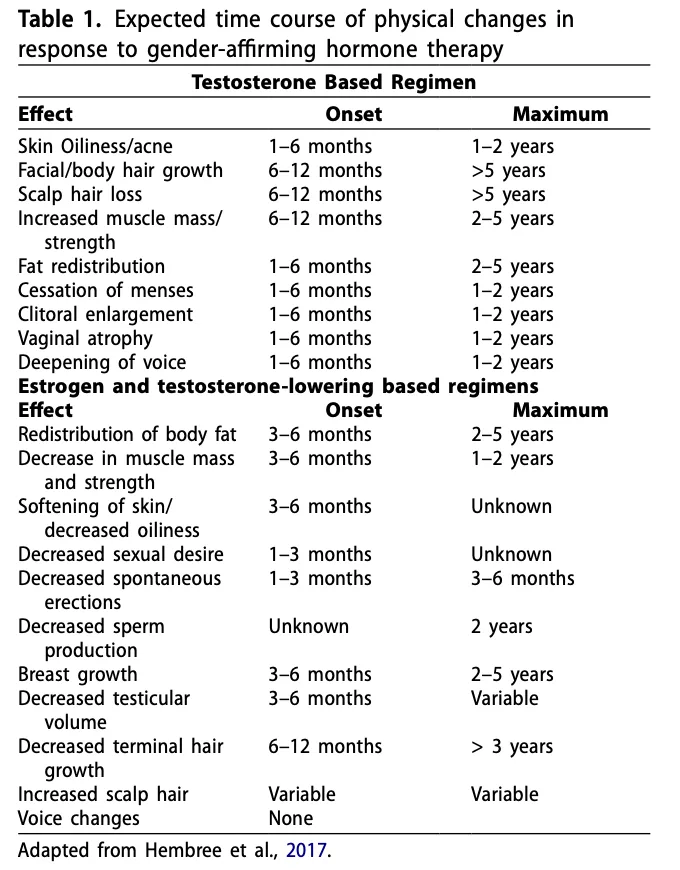
When counseling on expected changes from GAHT as part of the informed consent process, the Endocrine Society’s “Expected time course of physical changes in response to gender-affirming hormone therapy”, also featured in WPATH SOC8 (S254, told you!) is a great resource to review together at the first couple visits and hand to patients and family to take home. Basically, frame this one.
Timelines assume hormones are in the physiologic range of the affirmed gender, so are likely different for people who choose to take low-dose GAHT that results in hormone levels below the physiologic ranges.
Changes may impact future surgery outcomes:
- clitoral/bottom growth from T is desirable prior to metoidioplasty
- breast growth from estradiol prior to surgery also contributes to better breast augmentation outcomes,
- testosterone use before top surgery can improve aesthetics due to muscle (especially when combined with weightlifting) and chest hair growth.
Additionally, many insurances require a minimum time on GAHT (if indicated) prior to gender-affirming surgeries. Find out what the common requirements are in your payor population.
Working with patients on self-managed GAHT
You will likely encounter people who have chosen, for a variety of reasons, to turn to self-managed care, aka DIY-GAHT. Many of us are familiar with this happening in the abortion sphere, and a lot of of the reasons are similar. Remember: the goal isn’t perfection (each person’s gender path is unique) – it’s helping people access safer, evidence-based care wherever they are in their journey.
Key Points
- SRH clinicians who prescribe contraceptive hormones already have the foundational knowledge to initiate GAHT. The medications and monitoring frameworks overlap significantly.
- Assessment focuses on sustained distress, capacity to consent, and biopsychosocial context, including fertility goals, which should be addressed before starting treatment.
- For adolescents, a multidisciplinary approach is an important component of care.
- Lab monitoring follows a structured schedule: baseline, every three months during year one, then one to two times per year.
- Transdermal estradiol is preferred for patients over 45 or with VTE history; testosterone has relative contraindications including polycythemia and severe hypertension.
- WPATH SOC8 pages 254–255 summarize all adult GAHT treatment regimens: print or bookmark for quick reference.