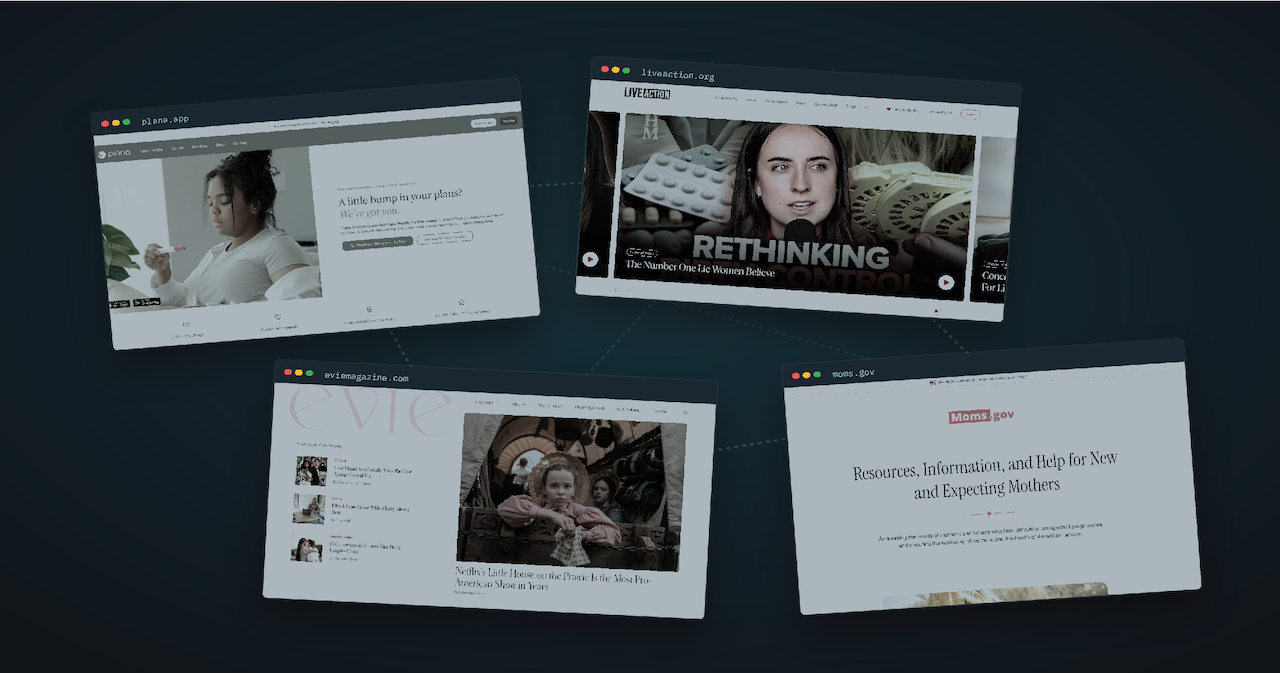


Social media mis/disinformation about sexual and reproductive health tends to get discussed one video at a time. A TikTok claiming birth control causes infertility. A YouTube clip dramatizing abortion risks. A before-and-after weight comparison that racks up millions of views. On Bedsider Providers, we know the real impact these videos can have, and tracking them matters. But behind the individual posts is often a more organized layer: coordinated platforms with editorial missions, institutional backing, and reach that extend well beyond any single creator’s audience.
The goal isn’t to debate every source with patients, but to recognize the framing when it shows up in how people describe their concerns, what they’ve been reading, and what they encountered when they searched for help. Four platforms in particular are worth knowing by name.
The sources
Evie Magazine
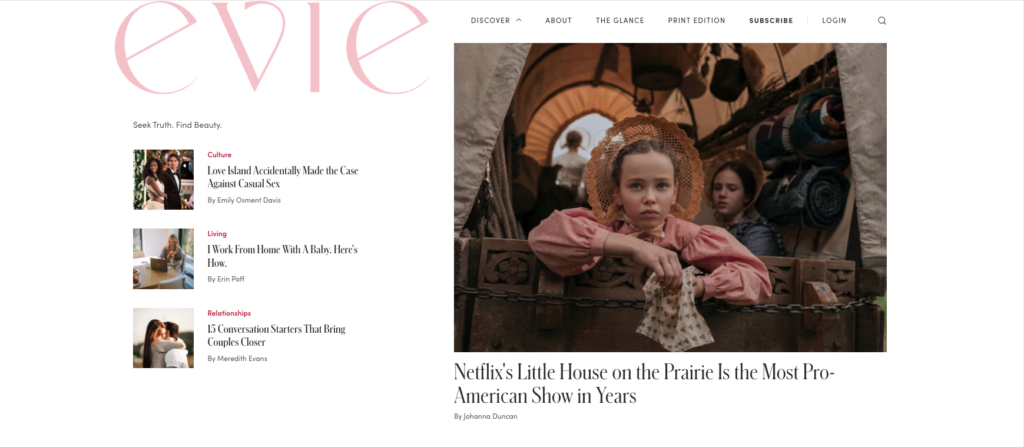
Founded in 2019, Evie Magazine describes itself as a “conservative Cosmo.” Evie uses the visual language and editorial tone of mainstream lifestyle media (fashion, beauty, wellness, relationships) to deliver a hard-right ideological message. Patients who would never click on overtly political health content click on a spring dress roundup or a luteal phase grocery list, and the SRH framing arrives after they’re already engaged.
By early 2025, Evie’s social content was generating approximately 100 million views per month. Recurrent claims include that the pill causes depression, infertility, personality changes, and autoimmune dysregulation. A Washington Post investigation described Evie’s approach as blurring the line between legitimate side-effect concerns and ideologically motivated fear campaigns.
And Evie’s reach extends beyond the magazine content through a companion app called 28, which promotes fertility awareness methods as the preferred hormonal contraceptive alternative without the broader efficacy context reputable medical sources provide.
Moms.gov
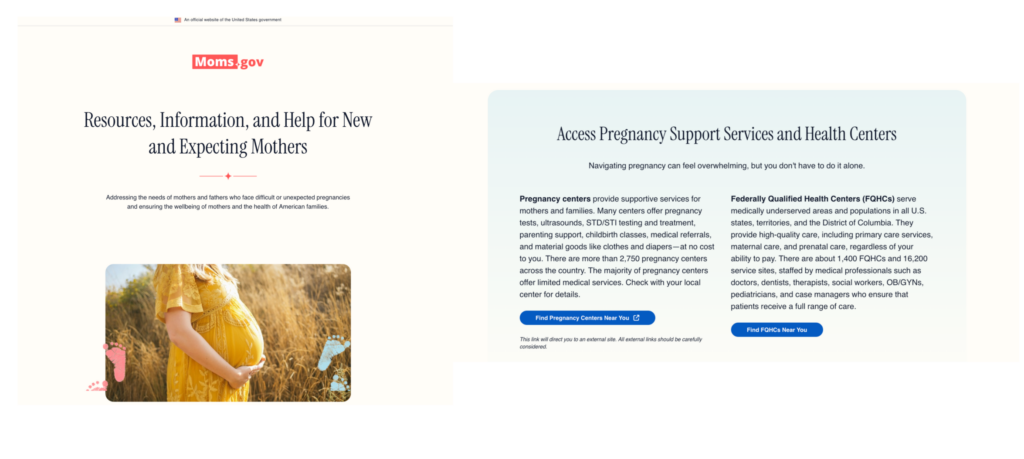
Launched on Mother’s Day 2026 by the Department of Health and Human Services, Moms.gov presents as a federal maternal health resource. On the surface, the site covers nutrition, breastfeeding, prenatal care, and mental health. What it does not cover is abortion or comprehensive contraception. A prominent “Find Pregnancy Centers Near You” button directs users to Option Line, a crisis pregnancy center (CPC) finder tool.
CPCs are unlicensed and unregulated facilities with a documented history of misleading pregnant people about gestational age, abortion safety, contraception, and their own medical credentials. By placing unregulated pregnancy clinics alongside federally qualified health centers on a federal .gov domain, the administration creates a dangerous false equivalency in the minds of patients who may assume .gov means medically accurate. CPCs are not bound by HIPAA, meaning that a pregnant person who clicks a Moms.gov referral may be sharing intimate health information with an organization that is not required to protect it. Patients who use Moms.gov expecting neutral federal guidance are likely to receive incomplete, ideologically curated information at a potentially vulnerable moment.
Live Action
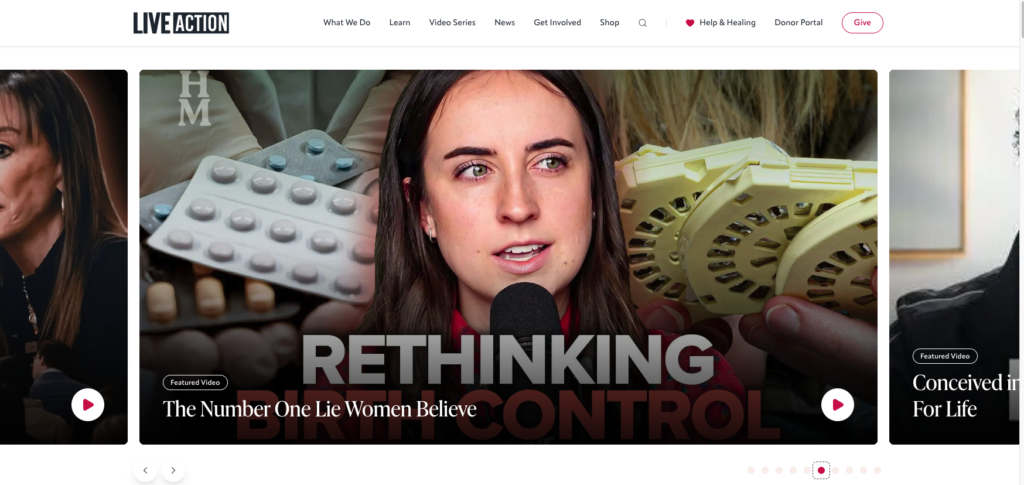
Live Action is an anti-abortion advocacy organization founded in 2003 with a significant, ongoing digital media operation. Unlike Evie Magazine, Live Action does not use lifestyle aesthetics to obscure its mission. It is explicitly anti-abortion and it produces health-adjacent content that mimics the format of medical information: explainer videos, “fact checks,” and procedure descriptions that are framed as educational but designed to generate fear. Live Action content has repeatedly appeared in Bedsider Providers’ MDI Trends tracker, including videos that exaggerate medication abortion complication rates, use sensationalist framing to describe D&C procedures, and suggest that medical institutions are concealing the “truth” about abortion safety. Live Action’s production quality is high, and its content is optimized for social media algorithms, which means it surfaces readily when patients search for information about abortion and contraception.
Plana
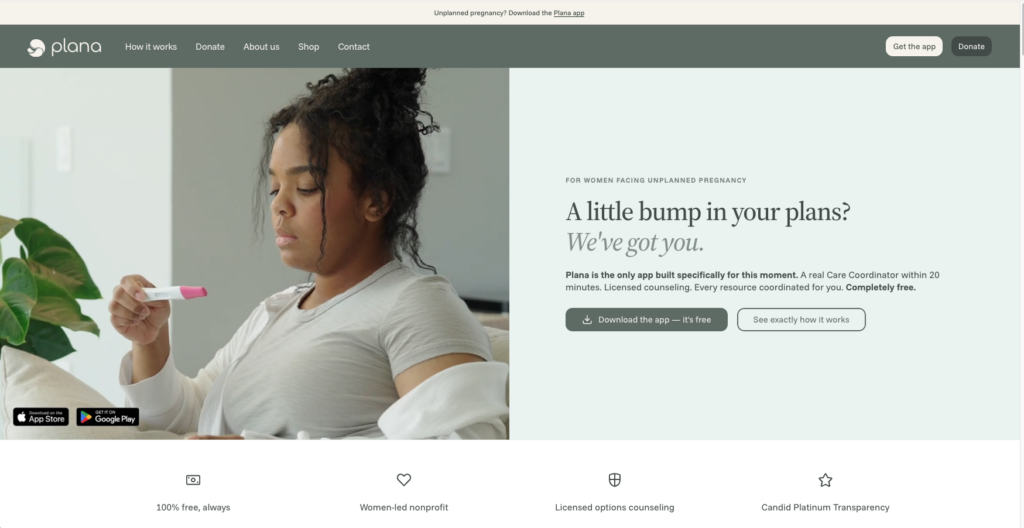
Recently launched, Plana is a nonprofit that describes itself as a support platform for women navigating unplanned pregnancies. It markets “licensed options counseling” and claims to discuss “all options.” However, as described in reporting from early 2026, Plana was promoted within Evie Magazine as a “life-affirming” resource, and the platform’s framing and referral network are anti-abortion. Providers should be aware that patients may be directed to Plana by Evie content or similar sources.
Why providers need to know these sources
Providers don’t need to follow these platforms or catalog every claim they produce. But it is important to be aware that patients often arrive having already absorbed some of their framing and often are unaware of where the framing came from.
This is the specific problem with Evie Magazine: it is designed to be invisible as an ideological source. A patient who has read 12 Evie wellness articles does not think of themselves as having been exposed to anti-contraception media. They think of themselves as someone who has been doing research and paying attention to their body. The same dynamic applies to Moms.gov, which carries the authority of a federal domain. A patient who found Moms.gov while searching for pregnancy resources may have arrived at a CPC without realizing the referral came with an anti-abortion agenda.
Live Action content surfaces in organic search results alongside clinical resources. And Plana presents as providing an unbiased source of options counseling. None of these sources announces itself as a political project. They all present as help.
There is also a data consideration. Recent reporting has documented CPCs collecting patient data and sharing it with anti-abortion organizations, which means a pregnant person who clicks a Moms.gov referral may unknowingly be handing intimate health information to a political operation. Patients who have used CPC-adjacent resources may have had their pregnancy-related search history or intake data shared in ways they did not anticipate. In these cases, a brief, non-alarmist mention can be relevant:
I think it’s important for people to know that some of those resources may not have the same privacy protections as a licensed provider. Everything you share with me is protected under privacy laws.
How to respond when patients have encountered these sources
Most patients won’t mention these sources by name. What you’ll hear instead are phrases like: “I’ve been reading that the pill messes with your real hormones,” or “I went to a pregnancy center and they told me medication abortion is really dangerous.”
The ASA Cycle is a useful framework here, and it works specifically because it doesn’t require the patient to identify their source or concede that they were misled.
If a patient expresses concern, start by affirming what’s true or understandable in what they’re saying.
It makes sense that you’d want to understand how hormonal contraception works in your body. A lot of people come in with the same questions.
Or, for a patient who arrived at a CPC:
It sounds like you were looking for support when you were in a hard moment. I’m glad you’re here now.
The share step should be focused, offering one clear, relevant piece of clinical information, not a point-by-point refutation. For a patient primed by anti-birth-control content: what the evidence actually shows on the specific concern they raised. For a patient who received incomplete options counseling: a clear statement that you’re here to discuss all of their options, including abortion, and that you can connect them with resources for any path they’re considering.
The ask step returns the conversation to them:
What’s most important to you in figuring out your next step?
OR
What questions do you still have after what you’ve been reading?
The goal isn’t to win the argument. It’s to build trust. The ASA Cycle approach is not about being soft on misinformation. It is about keeping the patient in the room long enough for accurate information to land.
Key Points
- Evie Magazine, Moms.gov, Live Action, and Plana are part of an organized SRH disinformation ecosystem that reaches patients often without patients recognizing the ideological framing of the content they’ve encountered.
- Evie generates approximately 100 million social media views per month through lifestyle content that embeds anti-contraception and anti-abortion messaging, and connects to the 28 cycle-tracking app and Plana through its editorial and promotional network.
- Moms.gov, a federal HHS website launched in 2026, uses .gov credibility to funnel patients toward CPCs that are not bound by HIPAA and have documented histories of providing medically inaccurate information.
- Live Action produces high-quality, algorithmically optimized health-adjacent video content that misrepresents medication abortion and procedural abortion safety and surfaces readily in organic searches.
- Plana presents as a comprehensive options-counseling app but provides biased, incomplete information about pregnancy options.
- Providers don’t need to track every post from these sources. They need to recognize the framing and use person-centered tools like ASA Cycles to respond in a way that keeps patients engaged with accurate, evidence-based care.