


Polycystic ovary syndrome has a new name. The condition is now polyendocrine metabolic ovarian syndrome (PMOS), following a global consensus process published in The Lancet in May 2026. The process drew on survey responses from more than 14,000 people with the condition and health professionals, and involved 56 academic, clinical, and patient organizations.
For clinicians, the practical news is reassuring: diagnostic criteria and evidence-based management remain largely the same. The new name puts endocrine and metabolic dysfunction up front, which is where much of the long-term health risk sits.
Implementation is underway across clinical guidelines, research, and disease classification systems, with a global transition period of about three years expected. As part of our ongoing series, the Reproductive Health Hotline (ReproHH) team walks us through what the change means for diagnosis, labs, and ongoing care.
Why did PCOS get a new name?
The old name pointed clinicians and patients toward the wrong feature. “Polycystic ovary syndrome” suggested that ovarian cysts define the disorder. Many people with the syndrome have no ovarian cysts, and many people with polycystic-appearing ovaries don’t have the syndrome.
PMOS is a complex endocrine and metabolic syndrome affecting about 1 in 8 women, or more than 170 million people worldwide. It involves reproductive, endocrine, and metabolic dysfunction. The new name reflects that range and supports holistic management of its reproductive, metabolic, and endocrine effects to reduce long-term health risks.
The previous terminology likely contributed to:
- Delayed diagnosis, with up to 70% of affected individuals remaining undiagnosed
- Fragmented care
- Stigma
- Decades of under-recognition and underfunding of research
Patients may still search for, and use, “PCOS” for some time. Using both terms during the transition (“PMOS, previously called PCOS”) can help patients connect new information to what they’ve already read.
How is PMOS diagnosed?
The diagnostic criteria have not changed. PMOS is diagnosed using the internationally endorsed modified Rotterdam criteria. After excluding other conditions that can mimic PMOS, adults must have at least two of the following three features:
- Oligo-anovulation
- Clinical or biochemical hyperandrogenism
- Polycystic ovarian morphology on ultrasound, or elevated anti-Müllerian hormone (AMH) when ultrasound is unavailable or impractical (AMH is only valid if at least 8 years post-menarche)
ReproHH has created a one-page diagnostic flow chart that walks through these steps:
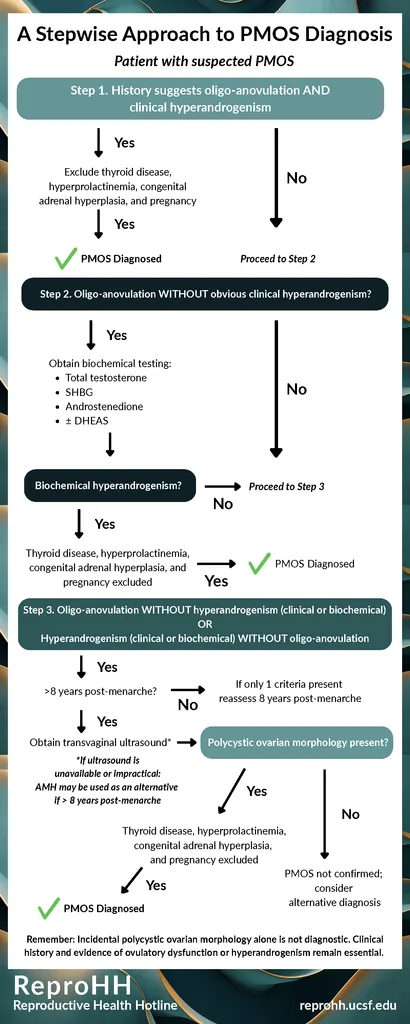
Download the ReproHH PMOS diagnostic flow chart (PDF)
How do I assess each diagnostic feature of PMOS?
Oligo-anovulation
Evidence of ovulatory dysfunction includes:
- Primary amenorrhea by age 15 or more than 3 years after thelarche (breast development)
- 1 to <3 years after menarche: a pattern of menstrual cycles lasting fewer than 21 days or more than 45 days
- ≥3 years after menarche through the menopausal transition: a pattern of menstrual cycles lasting fewer than 21 days, or more than 35 days, or fewer than 8 cycles per year
- Any menstrual cycle lasting more than 90 days occurring at least one year after menarche
Hyperandrogenism
Hyperandrogenism may be diagnosed clinically or biochemically. Clinical features include:
- Hirsutism (modified Ferriman-Gallwey score ≥4–8 depending on ethnicity)
- Persistent inflammatory acne
- Androgenic alopecia
Biochemical features include:
- elevated serum androgen concentrations, including total or free testosterone, androstenedione, and DHEAS.
Normal androgen levels do not exclude PMOS if one or more clinical features are present.
Polycystic ovarian morphology (only 8 years after menarche)
Polycystic ovarian morphology may be demonstrated by:
- Ultrasound showing ≥20 follicles in one ovary using modern high-resolution transvaginal ultrasound, or
- Ovarian volume ≥10 mL
Ultrasound should not be used for diagnosis until 8 years after menarche, because multifollicular ovaries are common during adolescence.
Anti-Müllerian hormone (AMH)
In adults, AMH may be used as an alternative to ultrasound when imaging is unavailable or impractical. Current guidelines recommend using assay-specific reference ranges rather than a universal cutoff. AMH should not be used for diagnosis in adolescents or within 8 years of menarche.
What should my initial workup look like?
Exclude alternative diagnoses early in the evaluation, including:
- Pregnancy
- Thyroid disease
- Hyperprolactinemia
- Nonclassic congenital adrenal hyperplasia
- Other causes of androgen excess when clinically indicated
Timing matters: Ideally, hormone testing should be performed during the early follicular phase (cycle days 2–4) in patients who are menstruating. How extensive the workup needs to be depends on the individual patient and setting.
Common lab tests in PMOS, their purpose, and typical findings:
| Test / assessment | Purpose | Typical finding in PMOS |
|---|---|---|
| Thyroid stimulating hormone (TSH) | Exclude thyroid disease | Normal |
| Total testosterone | Assess biochemical hyperandrogenism | Normal to mildly elevated |
| Sex hormone-binding globulin (SHBG) | Helps interpret free androgen levels | Often decreased due to insulin resistance (not diagnostic) |
| Androstenedione | Evaluate androgen excess | Normal to mildly elevated |
| Dehydroepiandrosterone sulfate (DHEAS) | Assess adrenal androgen production | Normal to mildly elevated |
| 17-Hydroxyprogesterone | Screen for nonclassic congenital adrenal hyperplasia | Usually normal |
| Estradiol | Evaluate ovarian estrogen production | Markedly low levels suggest hypothalamic amenorrhea or primary ovarian insufficiency rather than PMOS |
| Luteinizing hormone (LH) | Assess ovulatory function | Normal or mildly elevated |
| Follicle-stimulating hormone (FSH) | Assess ovarian function | Usually normal or low-normal |
| β-hCG | Exclude pregnancy | Negative |
| Prolactin | Exclude hyperprolactinemia | Normal |
| Anti-Müllerian hormone (AMH), adults only | Marker of ovarian reserve; supportive but not diagnostic | Often elevated (interpret using assay-specific reference ranges) |
| Transvaginal ultrasound Adults only | Assess ovarian morphology | Ovarian volume ≥10 mL or ≥20 follicles in either ovary |
How should I manage PMOS?
PMOS is a lifelong condition that calls for individualized, multidisciplinary care. Lifestyle modification remains the foundation of treatment.
Menstrual regulation
Combined oral contraceptive pills (COCs) remain first-line pharmacologic therapy for patients not seeking pregnancy. When appropriate, consider a monophasic pill containing 20 μg (0.02 mg) ethinyl estradiol combined with a low-androgenicity progestin such as norgestimate, drospirenone, or desogestrel.
Endometrial protection
Patients with chronic anovulation due to PMOS have an approximately two- to threefold increased risk of endometrial hyperplasia and endometrial cancer because of prolonged unopposed estrogen exposure. For patients with persistent anovulation who are not attempting pregnancy, provide regular endometrial protection with one of the following:
- Combined hormonal contraception
- Cyclic progestin therapy (micronized progesterone 200 mg PO QD X 10-14 days OR medroxyprogesterone 5-10 mg PO QD X 5-10 days) at least every 3 months
- A levonorgestrel-releasing intrauterine device (IUD)
Hyperandrogenism
- Spironolactone. Spironolactone should be used with effective contraception because of the potential risk of undervirilization of a male fetus.
- Laser hair removal or light-based therapies
Metabolic risk
- Screen for glucose intolerance at diagnosis and every 1–3 years with a 75-g OGTT
- Check blood pressure annually
- Obtain a lipid panel and provide smoking counseling at diagnosis
- Lifestyle intervention remains first-line
- Metformin is recommended for patients with insulin resistance, prediabetes, type 2 diabetes, or other metabolic features. It may be used alone or alongside lifestyle intervention and hormonal therapy.
- GLP-1 receptor agonists may be considered for patients with obesity or overweight and metabolic complications as part of a comprehensive weight-management strategy. Recent meta-analyses show improvements in weight loss and insulin resistance, although long-term reproductive and endocrine outcomes remain uncertain.
Fertility
For ovulation induction, letrozole is the preferred first-line medication.
What should I keep screening for long-term?
Beyond the reproductive and metabolic pieces above, build routine screening into ongoing care for:
- Depression and anxiety
- Eating disorders
- Cardiovascular risk factors
- Dysglycemia
- Obstructive sleep apnea, when clinically indicated
Patients with chronic anovulation are also at increased risk of endometrial hyperplasia and endometrial cancer. Ensure ongoing endometrial protection through combined hormonal contraception, cyclic progestins, or a levonorgestrel-releasing IUD.
When should I call ReproHH for help with PMOS?
The ReproHH clinical consultation line is available for questions about PMOS diagnosis in adolescents or atypical presentations, interpreting androgen and AMH results, choosing a contraceptive method for menstrual regulation and endometrial protection, and coordinating metabolic and hyperandrogenism management.
Call 1-844-ReproHH (844-737-7644) after reviewing their Terms of Service.
Key points
- PCOS is now called PMOS (polyendocrine metabolic ovarian syndrome).
- The diagnostic criteria have not changed. Use the modified Rotterdam criteria.
- Treat PMOS as a multisystem endocrine and metabolic disorder that extends well beyond the ovaries.
- Lifestyle modification remains the foundation of management.
- Build in long-term screening for metabolic disease and mental health conditions, and provide endometrial protection for patients with chronic anovulation.